

What types of hearing loss are there?
A complete guide to hearing loss: types, degrees and solutions
Hearing loss is far more common than most people realise. According to the World Health Organization (*), more than 430 million people worldwide live with moderate to severe hearing loss. Yet it remains one of the most underdiagnosed health conditions of our time.
One of the reasons is that it doesn’t always look the same. Some people gradually stop hearing high-pitched sounds. Others struggle to follow conversations in noisy environments. Some have lived with reduced hearing for years without knowing it. And others lose it so slowly they barely notice.
Finding the right solution starts with understanding what type of hearing loss is involved. There are three ways to classify it: by where the problem is located, by how severe it is, and by when it first appeared.
Types of hearing loss by location
The ear is made up of three parts: the outer ear, the middle ear and the inner ear. Depending on which part is affected, both the type of hearing loss and the treatment will differ.
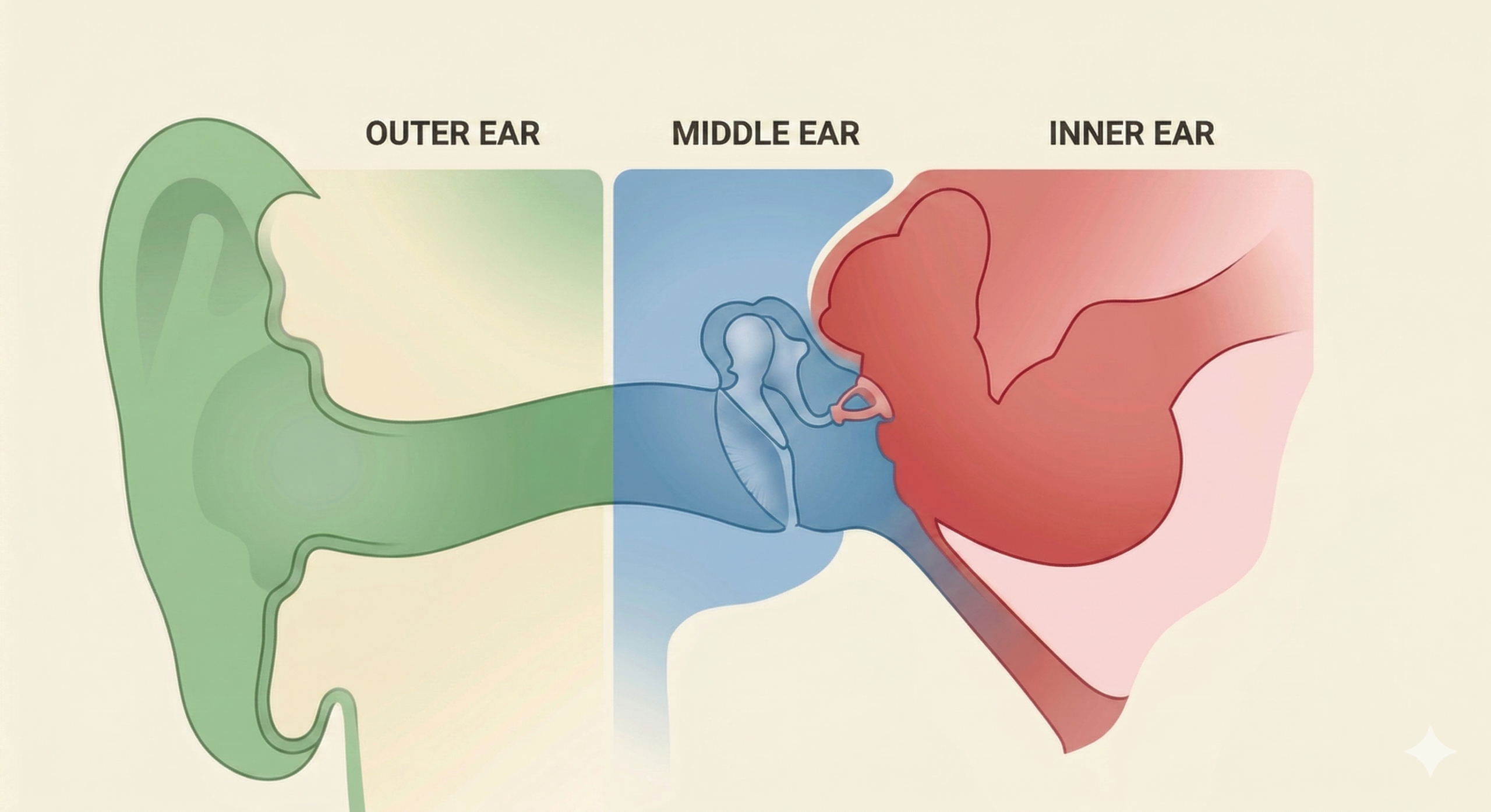
1. Conductive hearing loss
Conductive hearing loss occurs when something in the outer or middle ear prevents sound from reaching the inner ear properly. Common causes include earwax build-up, ear infections (otitis) or a perforated eardrum. This type of hearing loss tends to be mild to moderate and often has a medical or surgical solution. The person may hear less, but what they do hear sounds clear — sound quality is not affected.
2. Sensorineural hearing loss
This is the most common type of hearing loss in adults and older people. It happens when the hair cells inside the cochlea — the tiny cells responsible for converting sound into nerve signals — become damaged or die. Unlike conductive hearing loss, sensorineural hearing loss affects both the volume and the clarity of sound: the person not only hears less, but what they hear may sound distorted. It is usually progressive and permanent, but in most cases can be effectively managed with hearing aids.
3. Mixed hearing loss
Mixed hearing loss occurs when there is damage to both the outer or middle ear and the inner ear. It is particularly common in older adults. Treatment depends on the severity of each component and may include medication, surgery and hearing aid fitting.
Degrees of hearing loss
Hearing loss is measured in decibels (dB). Each degree has a different impact on daily life, ranging from difficulty following conversations in noisy environments to being unable to hear without assistance.
- Mild hearing loss (21–40 dB). Soft sounds, quiet voices and whispers are hard to hear. Many people at this stage are not aware they have a problem.
- Moderate hearing loss (41–70 dB). Following a conversation at normal volume becomes difficult. It is common to turn the TV up louder than others need it.
- Severe hearing loss (71–90 dB). Only loud sounds can be heard. Holding a conversation without help is almost impossible.
- Profound hearing loss (over 90 dB). Only very intense sounds or vibrations are perceived. High-technology solutions such as powerful hearing aids or cochlear implants are typically required.
It is worth noting that two people with the same degree of hearing loss may experience it very differently. Age, when the loss began and each person’s coping strategies all play a role. That is why every assessment needs to be tailored to the individual.
Congenital or acquired hearing loss: when does it appear?
Hearing loss can be congenital (present from birth or before language is acquired) or acquired, meaning it develops at some point during a person’s life.
When hearing loss is congenital, early intervention is essential. In Catalunya, all hospitals carry out newborn hearing screening to identify any problems as early as possible and support healthy language development.
Acquired hearing loss is by far the most common type. It can be caused by aging, prolonged exposure to loud noise, infections such as meningitis, or the side effects of certain medications.
Age-related hearing loss, known as presbycusis, typically develops gradually from around the age of 50. Many people put it down to getting older and never seek help. But catching it early makes a real difference to quality of life.
The first step is always a hearing test
Knowing what type of hearing loss a person has is essential to finding the right solution. And it all starts with a simple, painless and free hearing test: the audiometry.
A thorough hearing assessment should measure both the degree of loss — how much sound the person can detect — and speech understanding, meaning how well they can follow what is being said. These two dimensions together give a complete picture of a person’s hearing health.
Audiocontrol has its own centres in Girona, Barcelona and Mataró, and we bring our services to many towns and municipalities across the region. If you have any concerns about your hearing, or that of someone close to you, we are here to help.
🔗 Book your free appointment and start restoring your hearing health.


